- All
- Product Name
- Product Keyword
- Product Model
- Product Summary
- Product Description
- Multi Field Search
Views: 0 Author: Site Editor Publish Time: 2025-04-14 Origin: Site


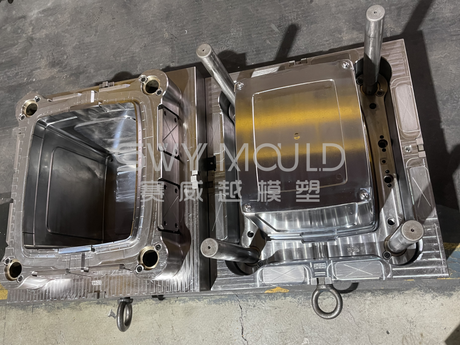
Making a good plastic box mould (crate, storage box, turnover box, container, etc.) requires special attention to warpage control, strength, and fast cycle time. Below is a practical, mould-maker–oriented guide, suitable for industrial and commercial box production.
Most box problems come from poor product design, not the mould itself.
Uniform wall thickness
2.5–4.0 mm (avoid thick corners)
Ribs instead of thick walls
Rib thickness = 50–60% of wall
Corner reinforcement
Large fillet radius inside & outside
Bottom strengthening
Grid or cross-rib structure
Draft angle
≥ 1.5° (≥ 3° for textured surfaces)
Perform Moldflow analysis to check:
Filling balance
Weld lines at corners
Warpage on long side walls
Common materials for plastic boxes:
| Material | Application | Notes |
|---|---|---|
| PP (Copolymer) | Turnover & logistics boxes | Tough, flexible |
| HDPE | Heavy-duty crates | High impact, higher shrinkage |
| PP + Talc | Stackable boxes | Better stiffness |
| ABS | Storage & tool boxes | Good appearance |
Confirm shrinkage before mould design
(PP: ~1.5–2.0%, HDPE: ~1.8–2.5%).
Plastic box moulds are large, flat, and prone to deformation.
Single cavity mould
Strong core support
Dense support pillars under bottom area
Replaceable inserts
Corners
Gate area
High-wear areas
Thick backing & clamping plates
Weak support = bottom warpage & flash.
Fan gate
Multiple edge gates
Ring gate (for round boxes)
Why?
Uniform filling
Reduced weld lines
Lower internal stress
Hot runner preferred
Shorter cycle time
Less material waste
Cold runner acceptable for low-cost moulds
Cooling determines flatness and cycle time.
Dense cooling lines under:
Bottom panel
Long side walls
Independent cooling zones for:
Bottom
Side walls
Use baffles & bubblers for deep cores
Cooling distance:
2–2.5 × wall thickness from cavity surface
Uneven cooling = bottom sink & side wall bending.
Boxes have large contact area with the core.
Stripper plate (best for thin boxes)
Ejector pins + ejector blocks
Large ejector pads under bottom ribs
Ensure uniform ejection force to avoid distortion.
Very important for box moulds.
Corner areas
End of flow paths
Bottom ribs
Vent depth:
PP / HDPE: 0.02–0.04 mm
Box moulds often run high volume production.
| Part | Recommended Steel |
|---|---|
| Core & cavity | P20 / 718H / 1.2738 |
| Wear inserts | H13 |
| Corrosion resistance | S136 (optional) |
Hardness: HRC 30–36
Smooth polish → Easy cleaning
Texture (MT / VDI) → Scratch resistance
Match texture depth with draft angle
During mould trials:
Check bottom flatness
Measure side wall deformation
Perform:
Stacking test
Drop test
Load test
Adjust gate size, packing pressure, or cooling if needed.
For long mould life:
Daily cleaning
Weekly lubrication
Regular cooling line flushing
Track shot count
| Item | Box | Chair / Stool |
|---|---|---|
| Main risk | Warpage | Load failure |
| Ejection | Stripper preferred | Pins & blocks |
| Cooling focus | Bottom & side walls | Seat & legs |
| Structure | Flat & wide | Tall & thick |
A good plastic box mould must:
✅ Fill evenly
✅ Cool uniformly
✅ Resist warpage
✅ Eject smoothly
✅ Be structurally strong
✅ Support long-term mass production
If you want, I can:
Review your box 3D design
Recommend gate quantity & positions
Design a cooling layout
Suggest steel grade based on output volume
Just tell me the box size, material, and production target