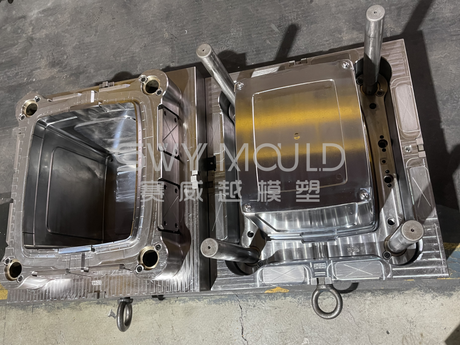
Making a good plastic chair mould requires getting design, material, tooling, and process control right from the beginning. Below is a practical, industry-proven guide, aligned with how high-quality injection moulds are built in professional mould company like SWY MOULD.
1. Chair Product Design (Foundation of the Mould)
A good mould starts with a correct chair design.
Key design rules:
Uniform wall thickness (typically 2.5–4.0 mm)
→ Prevents sink marks, warpage, and weak pointsRibs instead of thick walls
→ Rib thickness = 50–60% of wall thicknessProper draft angle
→ 1.5°–3° minimum (more for textured surfaces)Rounded corners
→ Avoid sharp edges to reduce stress crackingLoad-bearing reinforcement
→ Legs, backrest joints, and seat center must be strengthened
CAE / Moldflow analysis is strongly recommended to check:
Flow balance
Weld lines
Shrinkage & warpage
Gate location
2. Plastic Material Selection
Common materials for plastic chairs:
| Material | Advantages | Notes |
|---|---|---|
| PP (Polypropylene) | Low cost, flexible, impact resistant | Most popular choice |
| PP + Talc (10–30%) | Higher stiffness, less shrinkage | Needs stronger mould steel |
| HDPE | Tough, chemical resistant | More shrinkage |
| PA (Nylon) | Very strong | High cost, moisture sensitive |
Material shrinkage must be confirmed before mould design (critical for chair size accuracy).
3. Mould Structure Design
Plastic chair moulds are large, high-pressure, high-cycle moulds.
Core structure requirements:
Single cavity (mostly)
Chairs are large → single cavity ensures strength & stabilityStrong core & cavity support
Thick backing plates
Extra pillars under seat & legs
Insert design
Wear areas use replaceable inserts
Heavy mould base
Prevents deformation during injection
4. Gate & Runner System
Recommended gate types:
Fan gate (most common)
Edge gate with wide opening
Why?
Smooth material flow
Less stress marks
Better surface finish
Runner:
Hot runner system (highly recommended)
Saves material
Shorter cycle time
Stable filling
Brands often used: YUDO, Synventive, Husky, Chinese own brand, etc.
5. Cooling System (Very Important)
A good chair mould must cool evenly.
Best practices:
Dense cooling lines under:
Seat area
Leg roots
Backrest
Use baffle tubes & bubblers for deep areas
Keep cooling line distance:
2–2.5 × wall thickness from cavity surface
Poor cooling = warpage + long cycle time.
6. Ejection System
Plastic chairs require strong but even ejection.
Common ejection methods:
Ejector pins + ejector blocks
Stripper plate (for smooth ejection)
Extra ejectors at:
Seat center
Leg roots
Avoid ejector marks on visible surfaces.
7. Mould Steel Selection
Chair moulds run high tonnage & long cycles, so steel quality is critical.
| Part | Recommended Steel |
|---|---|
| Core & cavity | P20, 718H, 1.2738 |
| Wear inserts | H13, S136 |
| Sliders/lifters | H13 |
Heat treatment hardness: HRC 30–36 (P20/718H)
8. Surface Finish & Texture
Polish for glossy chairs
Texture (MT / VDI) for matte & scratch resistance
Texture depth must match draft angle
9. Trial, Testing & Optimization
During T1–T3 trials:
Check filling balance
Adjust packing pressure
Measure warpage
Load test the chair (static & impact)
Modify gates, cooling, or ribs if needed.
10. Mass Production & Maintenance
To keep mould quality long-term:
Daily cleaning during production
Weekly lubrication of sliders & ejectors
Regular checking of cooling lines
Record shot count & maintenance history
Key Summary
A good plastic chair mould must:
✅ Have a correct chair design
✅ Use suitable material & shrinkage data
✅ Be strong, well-supported, and well-cooled
✅ Use proper gating & ejection
✅ Be built with reliable mould steel
✅ Be maintained carefully during production
If you want, I can:
Review a chair 3D design
Recommend exact steel grades based on production volume
Suggest hot runner & gate layout
Provide a professional mould specification checklist
Just tell me